
The Communist Party of Nepal-Maoist, Nepali Congress, CPN-UML and Madhesi People's Rights Forum (MPRF) at a meeting held Monday night agreed in principle to form a coalition government under the leadership of former rebels, NC spokesman Arjun Narsingh Khatri Chhetri said.
The ongoing protests over the use of the Hindi language during oath-taking ceremony by Nepal Vice President Parmananda Jha on Monday took a violent turn in Kathmandu when the protestors clashed with police leaving 10 people injured. Six students, three policemen and a youth were injured when agitating students and youths clashed with the police near Amrit Science College in Kathmandu as normal life in the city nearly came to standstill, according to a private television.
Amid the political limbo over government formation, Indian-origin Madhesi leader Ram Baran Yadav was sworn-in as the first President of the nascent republic of Nepal on Wednesday, three days after his victory in the historic poll for the coveted post.
Yadav, a relatively unknown figure outside Nepal, was a last-minute choice of the major parties to oppose the Maoist candidate and Madhesi leader Ramraja Prasad Singh.
Nepalese Prime Minister Girija Prasad Koirala on Thursday resigned from his post, ending a two-month long deadlock to pave the way for the country's first ever Maoist-led government. Koirala, 83, announced his resignation while addressing the Constituent Assembly, which was elected in April to rewrite the constitution and govern the Himalayan nation, Nepali Congress Assembly member Tirtha Ram Dangol said.
In a sudden U-turn that could break the lingering political deadlock in Nepal, Maoists on Thursday decided to give up their claim on the post of president, paving the way for formation of a new government. Following its Central Secretariat meeting in Kathmandu, the Communist Party of Nepal-Maoist party also announced that it has withheld its decision to quit the interim multi-party government by Thursday.
Faced with a June 12 deadline, Nepal's ousted king Gyanendra on Monday assured the government that he will exit his Narayanhiti palace in Kathmandu within a week and live as a commoner, saying he is ready to make the "sacrifice for Nepalese people and permanent peace."
The 601-member assembly met at the Birendra International Convention Centre on Wednesday evening where a motion was passed to declare the country the world's newest republic. After a series of meetings, the Seven Party Alliance agreed to table the motion of republic in the first meeting of the Constituent Assembly, dominated by Maoists.
Ending a political deadlock, Nepalese Prime Minister Girija Prasad Koirala on Saturday invited the Maoists to form a government, more than a month after they emerged as the biggest party in the Constituent Assembly polls.
After leading his party to a surprise victory in the landmark Nepal polls, Maoist supremo Prachanda is now tackling a busy schedule, unable even to spare time to celebrate his victory or interact with the media. Prachanda had a meeting with Indian Ambassador Shiv Shanker Mukherjee, who went to congratulate him at his residence. The Maoist chairman also met human rights activists and went to Prime Minister Girija Prasad Koirala's Baluwatar residence to thank him.

Out of the 73 results declared so far, CPN-Maoists bagged 43 seats, CPN-UML - 12, Nepali Congress of Prime Minister Girija Prasad Koirala - 10, Madhesi People's Rights Forum - 5, Nepal Workers and Peasants Party - 2 and Terai Madhesh Democratic Party - 1. Determined to abolish the 240-year-old monarchy, Maoists in Nepal on Sunday emerged as the surprise single biggest gainers in the early results for the key Constituent Assembly polls,while several political heavyweights lost
The elections, which are set to usher in democracy ending the 40-year monarchy, saw the first seat going to Prime Minister Girija Prasad Koirala's Nepali Congress party, whose candidate Prkash Man Singh won one of the constituencies in Kathmandu. Maoist chairman Prachanda, Maoist war time strategist Ram Bahadur Thpa (Badal), its spokesman Krishna Bahadur Mahara and two female Maoist leaders Pampha Bhushal and Hisila Yami are leading in their respective constituencies.
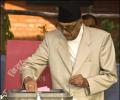
Polling started at 0700 hours (0645 IST) and will end at 1700 hours (1645 IST), election officials said. Some 6,000 candidates are contesting the election under proportionate voting system while 4,021 candidates are in the fray under direct voting system. The country has witnessed a violence-marred campaign for the crucial elections to elect a body that will rewrite the Constitution and decide the fate of the 239-year-old monarchy.
In an interactive programme at Rajbiraj, an eastern Nepal town, Prachanda claimed that his party Communist Party of Nepal - Maoist would get 150 seats out of a total of 300 seats in the direct election, and that he will become the first president of the Himalayan nation after the polls. He also sounded a note of apprehension over elections taking place on the scheduled date. "I am not confident that the CA elections will be held on the stipulated date," he said.
The Coummunist Party of Nepal - Maoist unveiled its election manifesto for the April 10 polls on Friday. They promised to abrogate the 'unequal' 1950 Indo-Nepal peace treaty, divide the country into 11 regions based on ethnicity and raise the per capita income ten-fold.The manifesto unveiled by Maoist chairman Prachanda in Kathmandu, ahead of the Constituent Assembly elections, describe India as an expansionist force.
A Nepalese minister indicated that it may take weeks or months for the tainted doctor to be sent to India.
Nepalese police on Friday decided to slap charges of illegal kidney transplants and foreign currency violations against alleged kingpin Amit Kumar as India wanted him to be handed over to the Central Bureau of Investigation at the earliest.
The agreement provides a 58-42 allocation for proportional and direct election systems for the 601-seat constituent assembly
Also known as 'Serpent' for his skills of deception and evasion, 63-year-old Sobhraj had filed an appeal in the apex court against the life sentence given to him by the Kathmandu District Court, for the murder of American backpacker Connie Bronzich. He is suspected to have killed at least 12 travellers in India, Thailand and Nepal in the 1970s.
The Indian official is arriving in Kathmandu on a two-day visit on Wednesday afternoon to take stock of the political situation that has developed after a lack of consensus over Maoist demands for declaring the country a republic led to the postponement of November election.
 © 2026 Rediff.com - Investor Information - Advertise with us - Disclaimer - Privacy Policy - Sitemap - Feedback - About us - Terms of use - Grievances